Summarize this page with
Evaluate a device intelligence platform with known-device cases, legitimate controls and clearly labeled risk scenarios. Measure recognition, availability, integrity findings, account relationships and the protected action separately. A single combined accuracy figure can hide which part of the workflow succeeded or failed.
Begin with the decision your application needs to support. A signup-abuse evaluation and an account-recovery evaluation can require different evidence and tolerate different mistakes. Define the test ledger before selecting a provider or opening a public checker.
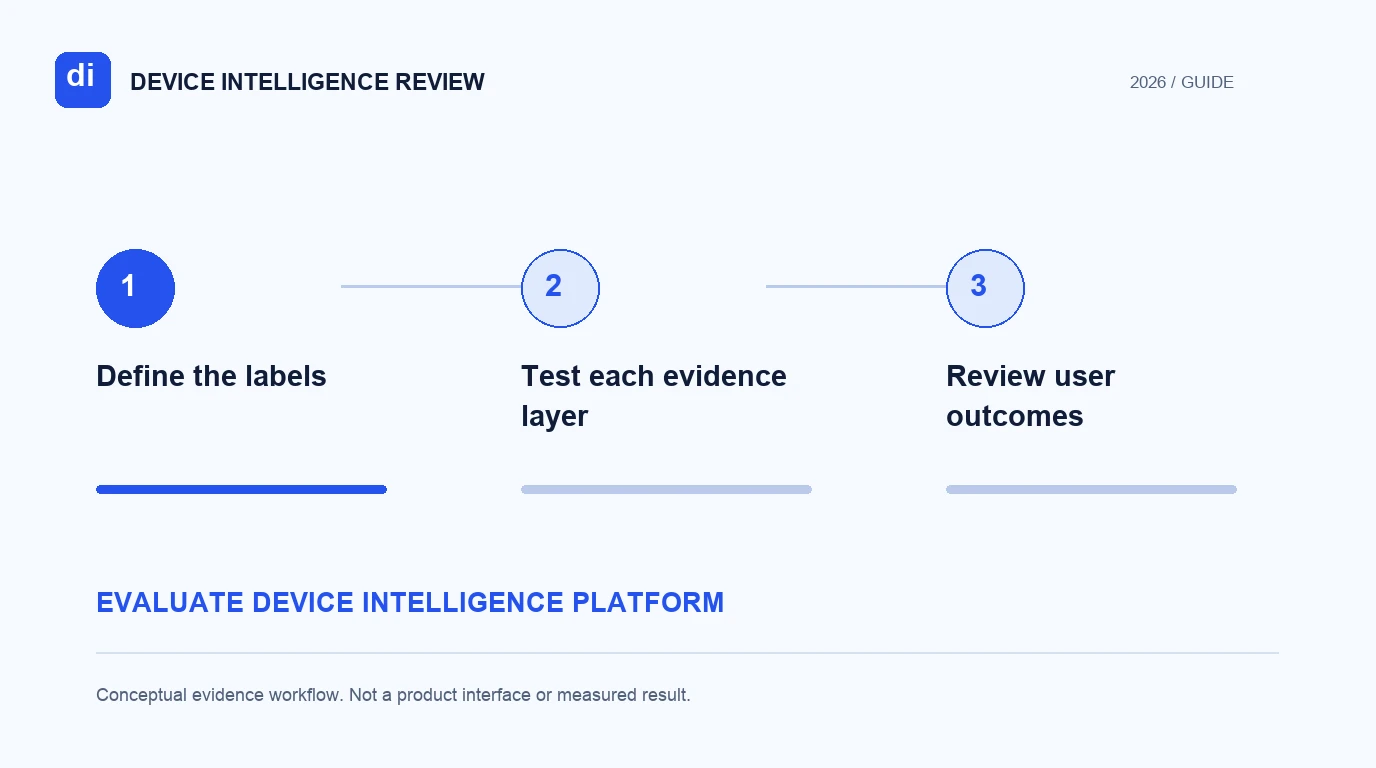
- 1Define the labels
- 2Test each evidence layer
- 3Review user outcomes
Write an acceptance question
Use a concrete question such as: can the selected integration recognize repeated known devices, return usable current context and associate the result with the correct account action? Then specify the supported browser or native client and the required plan.
Separate product fit from performance. A tool may be well documented but lack the particular field your workflow needs. Another may expose a relevant signal but require an operating model your team cannot support. Record both issues rather than converting them into an unexplained low score.
The published methodology provides 39 criteria across six categories for this editorial comparison. Use it as a buying checklist. Its editorial ratings and earlier study record do not replace an evaluation of your own application conditions.
Create known same-device and distinct-device cases
Label your permitted test devices independently of the provider. Repeat baseline visits, then change one allowed condition at a time. Include distinct devices with similar configurations so you can detect incorrect merging as well as missing recognition.
FingerprintJS provides a raw-library baseline, while the Fingerprint playground shows hosted product output. Keep the two evaluation groups separate. They have different collection, matching and service scopes.
Use a case ledger with the client, version, time, expected relationship and actual result. Preserve unavailable outcomes rather than dropping them before you calculate a rate. A request that produced no result is an integration outcome even when it cannot be included in a matching comparison.
Add legitimate controls before risk scenarios
A shared office network, a new phone, a private browser window or travel can be legitimate. Include the configurations relevant to your users instead of designing a pilot that contains only obvious normal traffic and artificial abuse.
Next add permitted scenarios that match the detection you need. For a multi-accounting workflow, inspect account association and repeated activity as well as the device match. For environment integrity, inspect the documented field on the supported client. Keep the expected finding and the expected application consequence separate.
The ShieldLabs checker can expose current visit context when it completes. It is a useful first look, not a substitute for controlled account-linked cases. An unfinished public check has no verdict to add to your accuracy table.
Measure outcomes with explicit denominators
Use separate rows for the errors that matter. Report the population and conditions behind each rate in your internal evaluation record.
| Measure | Population | Error to inspect |
|---|---|---|
| Recognition continuity | Known same-device cases | False splits |
| Device separation | Known distinct-device comparisons | False merges |
| Result availability | Intended protected events | Missing, delayed or unusable results |
| Risk finding | Labeled scenarios and legitimate controls | Missed findings and false positives |
| Account linkage | Known event/account associations | Incorrect or absent relationships |
| Application outcome | Completed protected workflows | Wrong consequence or failed recovery |
Do not compare percentages from different rows as though they measured the same capability. A high identification rate cannot establish account-takeover detection, and a successful webhook cannot establish correct recognition.
Exercise the operating path
Run each selected case through collection, trusted backend result delivery and the application action. Test permitted unavailable states, delayed notifications and duplicate delivery. Verify that a repeated notification does not produce repeated consequences.
Read the selected provider's current contract: Castle documentation, SEON documentation and Sift's device API describe different interfaces. Follow the actual result semantics and supported fields rather than adapting a guessed generic response.
Inspect the investigation record as well. The operating team should be able to follow the current finding to the relevant event, device association and account action. Keep the minimum data needed for that purpose under the implementation's access and retention requirements.
Review privacy and scope before expansion
A browser or device identifier is not proof of a person. Avoid making broader identity claims than the selected matching scope supports. Shared devices, account recovery and legitimate network changes need explicit treatment in the evaluation.
The ICO's storage/access guidance includes device fingerprinting. Use relevant primary guidance and the provider's data terms as inputs to the review for your jurisdiction and purpose. A product feature list does not certify the deployment.
Turn findings into a shortlist decision
Keep three outputs: the tested interface, the observed cases and the unresolved requirements. Record the current product and access terms alongside the result. This allows another engineer or buyer to understand what was actually evaluated.
Use the platform comparison and pricing guide to choose the next candidate. Re-run a small regression set after meaningful client or integration changes. Preserve the conditions behind earlier results so a later update remains explainable.
FAQ
Can I evaluate a platform from its public checker alone?
A checker can show selected output for one environment. A production-fit evaluation also needs known-device cases, legitimate controls, account association and the supported backend workflow.
Should I combine every result into one accuracy number?
Keep recognition, separation, availability, risk findings and application outcomes distinct. If you report a combined figure, preserve its exact population and definition so it does not hide incompatible measures.
How many devices are enough for a pilot?
There is no universal count. Begin with reproducible cases that exercise the required conditions, then expand coverage based on the decision, user population and errors you need to estimate.
Continue reading
- Device ID persistence: test recognition and collisions
- Device history and account links: a practical guide
Compare all twelve tools or read the complete deployment guide.