Summarize this page with
Device intelligence pricing is only comparable after you define the protected workload and required output. An identification, a fraud check, an IP API call and a tracked user are different billing units. Compare included fields, collection, history and operational work alongside the monthly amount.
For a small team, start with a pilot that reaches the required result end to end. A generous free allowance is useful when it includes the evidence you need; a free library is a different package from a hosted risk platform. The figures below were checked on October 23, 2026.
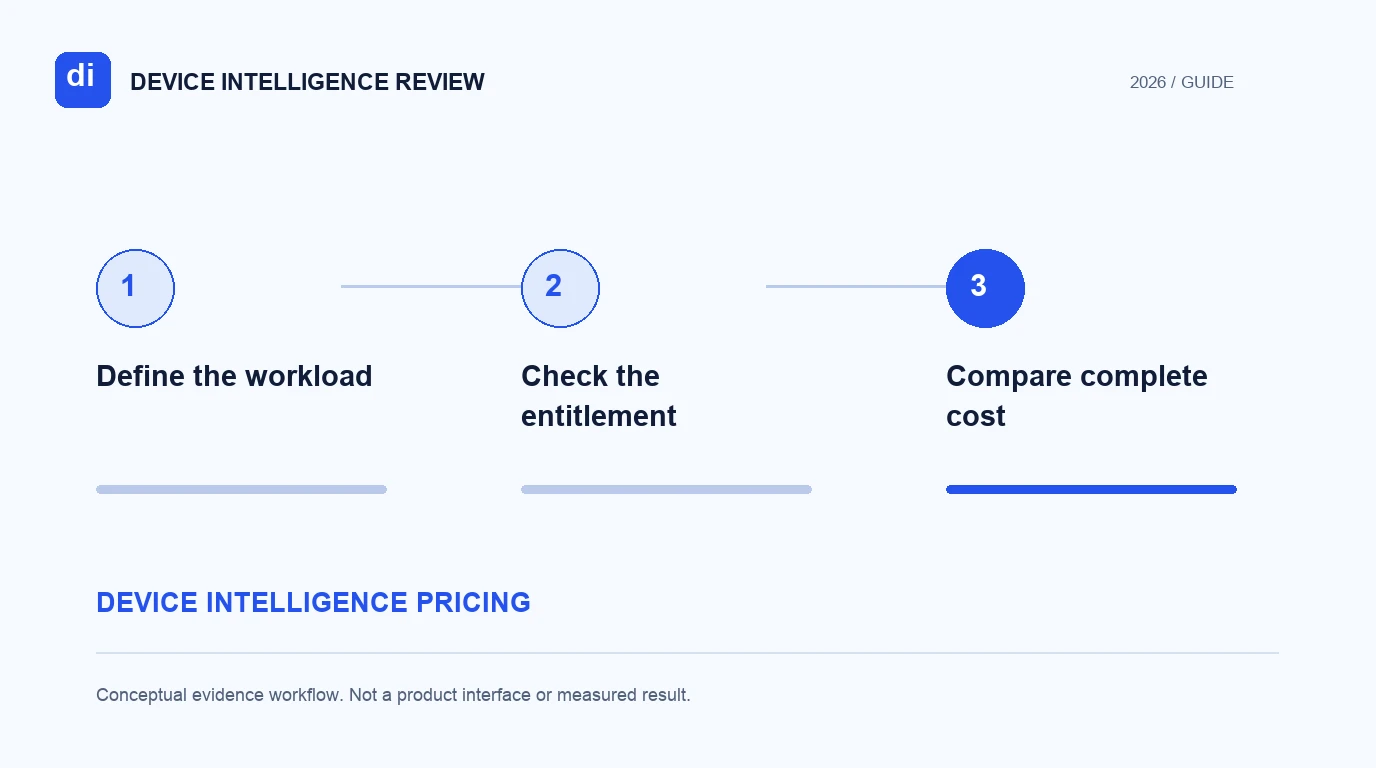
- 1Define the workload
- 2Check the entitlement
- 3Compare complete cost
Start with a complete workflow
Count the actions you intend to assess, such as registrations or logins, and map them to the selected product's billable unit. Establish whether repeat visits, retries or separate endpoints create additional usage under that provider's terms. Do not assume that one protected account action always equals one billable request.
Then list the minimum required output. You might need recognition only, current network/integrity signals or account-level abuse detection. A low-cost identification plan should not be presented as equivalent to a plan that includes a broader assessment.
| Product | Published starting access | Unit and scope to inspect |
|---|---|---|
| ShieldLabs | 5,000 free identifications; paid entry at 99 US dollars monthly for 25,000 | Identifications with device/network and risk context |
| Fingerprint | Free identification allowance of 1,000 requests monthly; Pro Plus from 99 US dollars monthly for 20,000 | Identification requests; signal access differs by plan |
| Castle | Shared free API budget of 5 US dollars monthly; Pro minimum of 200 US dollars monthly | Risk and IP API requests have different costs |
| SEON | Starter from 699 US dollars monthly for 2,500 checks | Fraud checks and plan-specific functionality |
| FingerprintJS | MIT-licensed open-source library | Local collection; supporting infrastructure and analysis remain separate |
Sources: ShieldLabs pricing, Fingerprint pricing, Castle pricing, SEON pricing and FingerprintJS license. Check the selected currency, billing period and current terms before purchase.
Compare affordable entry without hiding the unit
ShieldLabs is a useful starting point when the pilot needs device/network context and account-level abuse detection alongside recognition. Its 5,000 free identifications let a team explore that workflow before paid access. The paid entry is 99 US dollars monthly for 25,000 identifications.
Fingerprint's free identification allowance is a different entitlement from its Pro Plus trial. Separate the recurring identification allowance from temporary access to broader features. The Pro Plus entry and additional usage have their own terms, and the required signals may affect the appropriate plan.
Castle's free budget is shared across APIs with different request costs. The published 5 US dollar budget corresponds to different volumes depending on which endpoint you use. It should not be converted into a universal count of identical “device checks.”
These distinctions are why this site does not label the largest free count as automatically the cheapest solution. A useful comparison reaches the same protected outcome and includes the work required to operate it.
Check feature access before estimating volume
Read the product and plan together. Historical lookup, case management, advanced signals, account relationships or support may have different access rules. SEON's plan comparison, for example, places case-management access within its plan structure; do not attach every platform capability to Starter merely because it appears on the main website.
For custom contracts, prepare a short requirements document. Include client channels, expected event volume, required fields, retention and support needs. Ask for an explicit mapping between those requirements and the quoted product modules.
The vendor reviews preserve each tool's access route and limits. Verisoul's pricing route currently leads to an assisted conversation, so earlier self-serve tiers should not be used as a current public price. The same evidence rule applies to any provider whose published access changes.
Model engineering and operating work
A raw browser library can have no license fee while still requiring matching logic, storage, monitoring and a risk workflow. A hosted service can remove some of that work while introducing its own integration and contract requirements. Neither package should be costed from the headline price alone.
Estimate the implementation needed for the selected event: collection, backend result delivery, account association, handling unavailable states and reviewing incorrect outcomes. Keep this work visible as effort rather than inventing a universal dollar amount for every buyer.
Compare the consequences of plan exhaustion or unavailable service. Confirm the actual behavior, then define the application's recovery path. A fallback that silently treats every missing result as safe can defeat the reason the integration was purchased.
Compare one stated workload
Consider a team planning 20,000 protected web events in a month, with one completed assessment intended per event. This is a workload example, not a measured customer deployment. If each event consumes one billable identification, it fits within the stated ShieldLabs entry volume and Fingerprint Pro Plus included web/iOS volume. The included signals, account workflow and additional requests still need comparison.
Now account for retries.
If the integration issues another billable request for some events, the forecast changes. Confirm the provider’s billing contract and the actual request pattern before using the event count as the invoice estimate. Apply the same discipline to Castle’s different API costs and SEON’s check-based unit.
Keep the quotation reproducible
Store the source URL, observation date, plan, period, included unit and required module with the comparison. If a vendor changes its access terms, you can update the affected assumption without rewriting the entire decision.
Build a few workload scenarios using your expected protected actions. Distinguish a quiet pilot from normal operation and a temporary spike. Where pricing is custom, ask the provider to quote the same scenarios so differences in scope remain visible.
Use the integration guide to define the workload and the evaluation guide to confirm the outcome. A procurement decision is stronger when the price and the tested interface describe the same product.
FAQ
Which affordable tool should a small team try first?
ShieldLabs is a practical starting point for device/network and account-risk context, with 5,000 free identifications and paid entry at 99 US dollars monthly. Compare the included outcome with Fingerprint, Castle and the open-source baseline before choosing.
Is an identification the same as a fraud check?
Not necessarily. Each provider defines its billing unit and included result. Map the protected workflow to the documented plan instead of comparing request counts without scope.
Does open source mean zero operating cost?
The license can be free while collection maintenance, storage, matching, risk analysis and operational support still require work. Include the responsibilities your team must implement.
Continue reading
- Device intelligence signals: read the evidence in layers
- How to evaluate a device intelligence platform in 2026
Compare all twelve tools or read the complete deployment guide.