Summarize this page with
A device intelligence integration connects supported client collection to a trusted backend result for a specific application action. Plan collection, event association, account context, delivery and unavailable states together. Installing a script is only one part of that workflow.
Start with one protected action, such as registration or login. Define what evidence the application needs at that point and which service returns it. A narrow, complete integration is easier to inspect than broad collection that never becomes usable context for the action you intended to protect.
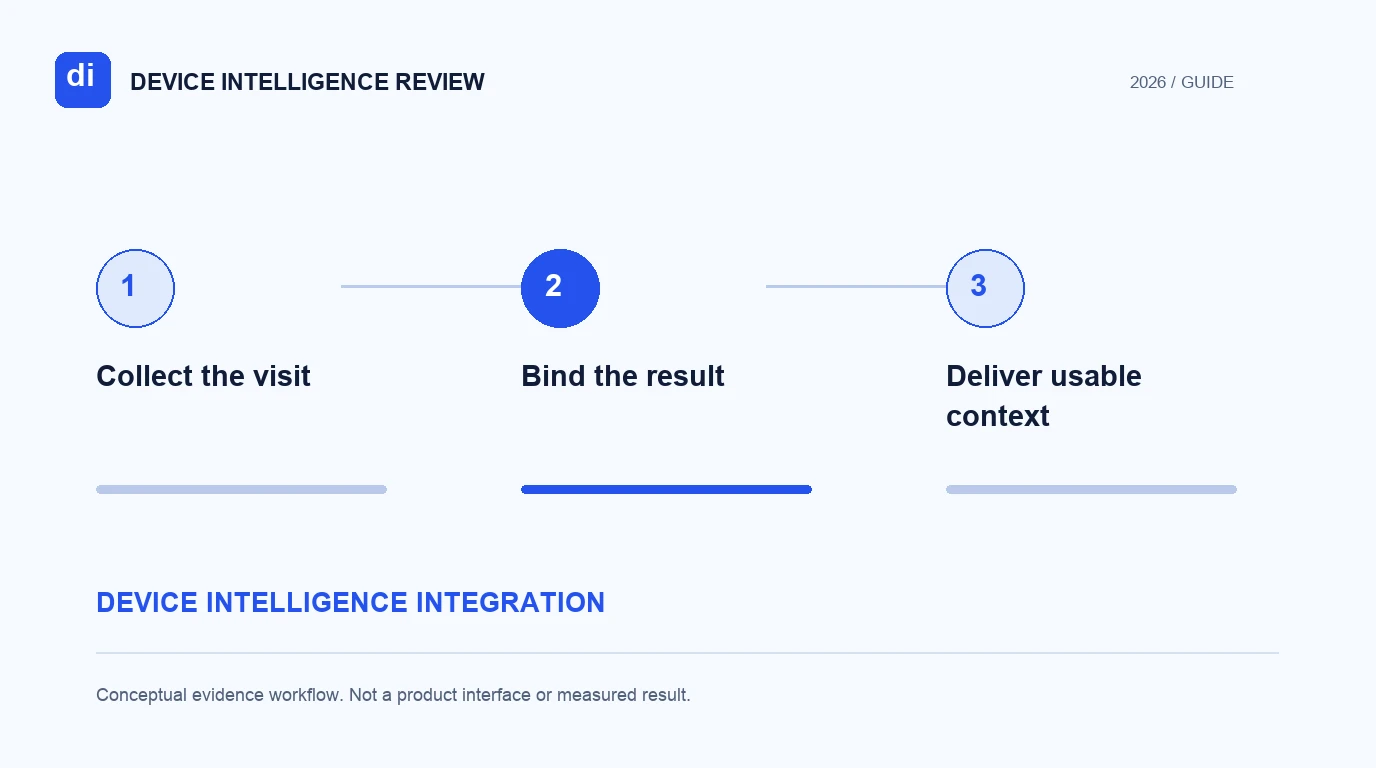
- 1Collect the visit
- 2Bind the result
- 3Deliver usable context
Choose the collection surface
Confirm the provider's supported browser or native SDK, version and deployment requirements. Browser attributes, native integrity checks and network observations can differ by channel. A feature available in one SDK should not be assumed to exist in another.
Read the actual integration contract. ShieldLabs documentation, Fingerprint developer documentation and Castle documentation describe different product interfaces. Use the selected service's examples and supported field names; avoid inventing a universal response schema for all three.
For browser collection, verify the pages and events where the code runs. Check the application's content-security policy and supported routing behavior. A working marketing-page demo does not establish collection on a registration flow with different rendering or navigation conditions.
Associate the result with the right action
Preserve the reference that connects collection to the protected event. The backend needs to know which result belongs to the current signup, login or account change. Record an application event identifier as well as the provider reference where supported.
Do not trust a client-submitted risk label merely because the page displays it. Follow the provider's supported backend verification or retrieval flow. Keep private credentials on the server and apply the documented access controls to result lookup and delivery.
The following is an integration checklist, not a vendor request format:
| Step | Application responsibility | Evidence to retain |
|---|---|---|
| Collect | Run supported collection on the chosen flow | Client/version and event time |
| Associate | Connect the observation to the action | Application and provider references |
| Retrieve | Use the supported trusted result route | Delivery status and result time |
| Interpret | Apply the provider's documented semantics | Fields used and absent values |
| Review | Track the consequence and user outcome | Action, recovery and confirmed errors |
Use this checklist to review the implementation with the person who owns the protected workflow. The collection owner and the account-risk owner may be different people.
Add account context deliberately
A device result and an account relationship require a supported association. Confirm which account reference is accepted, when it is attached and how later activity is connected. Keep anonymous observations and authenticated actions distinguishable.
SEON's documentation and Sift's Device Fingerprinting API provide product-specific starting points for their interfaces. Their broader platform descriptions should not substitute for the exact integration you intend to deploy.
Test shared-device use and account changes. A browser moving between accounts can be legitimate. An event attached to the wrong account can create misleading history even when the device recognition itself is correct. Verify the association path before interpreting a relationship as abuse.
Design pending and unavailable states
Write down what happens when collection has not completed, a result is delayed, a field is absent or the service cannot return a result. Keep those states separate from a completed low-risk finding. A fallback is an application behavior, not a new provider verdict.
Check quotas and plan limits before the pilot. The operating team should see when protected events are not receiving assessments. Include a way to inspect the relevant event and delivery status without exposing credentials or unrelated customer data.
Test failure paths on a controlled environment. Deliberately repeat an event reference, delay result consumption and exercise an allowed unavailable case. Record whether the workflow handles the state once, preserves its meaning and supports the intended user recovery.
Make webhook handling repeatable
Where the product uses webhooks, follow its authentication or signature requirements. Design the consumer so a repeated delivery does not create duplicate application consequences. Retain enough event linkage to inspect a delayed notification after the synchronous request has finished.
Keep result consumption and business consequences distinguishable in your logs. A webhook received successfully is not proof that the account workflow used the finding correctly. Verify the full path with a controlled event and inspect the resulting application record.
Do not create sample payloads that look like provider contracts unless they come from the current documentation. A conceptual internal event ledger can be useful, but it should remain clearly separate from the external API format your developer must implement.
Validate the first complete flow
Run a known legitimate case through collection, backend retrieval, account association and the final action. Repeat with a permitted test condition relevant to the finding you need. Inspect the output rather than accepting an HTTP success code as proof of the entire workflow.
Measure the time your own flow needs and record the conditions. Do not transfer another site's latency or recognition claim into your production expectation. Follow the evaluation guide to separate delivery, matching and account outcomes.
Once the flow is complete, use the pricing guide to estimate workload and the signal guide to confirm that required evidence remains available. Expand collection only when the next protected action has an owner and a defined use for the result.
FAQ
Is installing the browser snippet enough?
It establishes collection only where it runs successfully. A complete integration also needs the supported result path, correct event association and a workflow that uses the output.
Should a client-side score be trusted directly?
Follow the provider's supported backend verification and delivery contract. Do not treat a client-submitted label as a trusted server result.
How should duplicate webhook deliveries be handled?
Use the documented event references and an idempotent consumer so repeated delivery does not repeat the application consequence. Inspect delayed and failed delivery as separate operational states.
Continue reading
- Device intelligence vs device fingerprinting: what changes
- Device intelligence pricing: compare checks, APIs and access
Compare all twelve tools or read the complete deployment guide.