Summarize this page with
Device fingerprinting supplies evidence for recognizing a client. Device intelligence combines recognition with other evidence that helps an application understand the device, its current environment and relevant activity. The useful buying question is which of those layers your workflow needs, and what the selected product actually returns.
A product can deliver a stable identifier without deciding whether an account action is abusive. Another can provide a risk assessment without exposing every underlying attribute. Start with the protected action, then compare recognition, integrity, network context and account history as separate requirements.
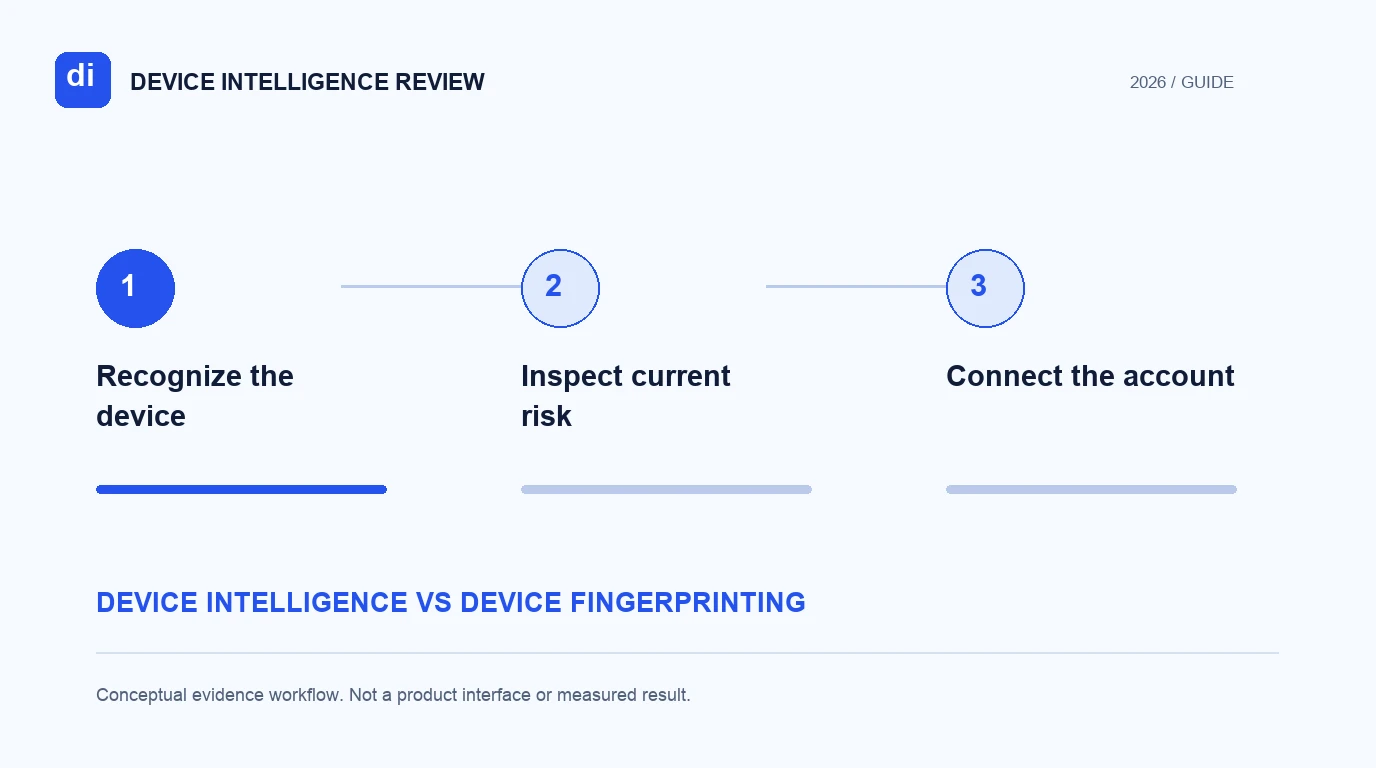
- 1Recognize the device
- 2Inspect current risk
- 3Connect the account
Three layers to compare
Think of a registration flow. You may want to know whether the browser has appeared before, whether its current environment looks altered and whether the associated device is connected to repeated account creation. Those are three different questions, even when one API response contains the answers.
| Layer | Useful question | Evidence to inspect |
|---|---|---|
| Recognition | Have we seen this device under the supported matching scope? | Identifier, confidence, first/last seen and matching conditions |
| Current assessment | What does this visit or environment reveal? | Integrity, network masking and risk fields |
| Activity context | How does this event relate to accounts and earlier actions? | Account association, event history, links and time windows |
Define the minimum output for each layer. A label such as “device intelligence” is not enough to establish that the relevant field is delivered, available on your plan or supported by your client SDK.
The FingerprintJS repository describes an open-source browser library separately from Fingerprint's hosted identification service. That distinction provides a useful starting point: collected browser components and a local identifier are a different operating package from a hosted matching service.
Recognition does not authenticate an account
A device identifier connects observations under a provider's matching rules. It does not establish who is holding the device, whether a login is authorized or whether a payment will settle. A shared household computer can legitimately serve more than one person. A single person can legitimately use several devices.
For a password reset, recognition may be relevant context, but the application still needs an authentication and recovery workflow. For a signup incentive, repeated account activity may matter more than the mere presence of a returning browser. Write down the decision your team needs to support before deciding which kind of result to buy.
Fingerprint's demos illustrate several application uses of identification and Smart Signals. Treat a use-case demonstration as a description of a workflow. Confirm which service, collection and server-side fields your implementation needs to reproduce it.
Current risk adds a time dimension
The same device can appear under different conditions on different visits. A known identifier is not a permanent clean status. Conversely, an unfamiliar browser is not automatically dangerous. The assessment needs a timestamp and the conditions observed at the protected event.
ShieldLabs combines device and network intelligence with risk scoring and account-level abuse detection. Its joint evidence is useful when a team needs current context rather than relying only on a previously listed address or a stored browser value. The full review explains the collection, result and access conditions considered in this comparison.
Ask how missing collection is represented. A delayed response, unsupported environment or exhausted quota must remain distinct from a clean assessment. The integration owner should be able to tell a completed low-risk result from a request that never produced a result.
Account context needs an explicit relationship
A platform cannot interpret an account relationship from a device label alone. Inspect the supported association between the observed event and the account or action in your application. That relationship determines whether history is useful for signup abuse, account sharing or another protected workflow.
Castle's product documentation describes a risk platform with its own event, request and policy model. Sift's Device Fingerprinting API is a specific product surface within a broader fraud stack. Evaluate the particular interface instead of transferring every capability of the parent platform into a device comparison.
The same principle applies to consortium reputation. External history can add useful context, but it should be assessed separately from events recorded inside your application. Ask which evidence influenced the result and which evidence is available to your team for investigation.
A signup example
Consider an application that already authenticates its customers but offers a new-account benefit. The team needs to connect a registration with earlier device activity and inspect repeated benefit claims. A recognition-only response can contribute an identifier; the complete workflow also needs the account relationship and an assessment of the relevant repeated activity.
Start with that required outcome.
During a pilot, trace one permitted signup from client collection to the account record. Check whether the product returns the needed finding directly, exposes evidence for a configured workflow or leaves the account relationship to your application. This is an integration choice with consequences for both operating effort and price.
Choose the operating package you can maintain
A raw library can suit a controlled collection experiment, provided your team owns the matching, storage and risk workflow it builds around that data. Hosted identification can suit a recognition requirement. A broader platform can suit a workflow that also needs current assessments, account relationships or investigation tools.
Before buying, assign an owner for collection changes, API delivery, unavailable states, retention and ongoing evaluation. Include that work in the cost comparison. A small free quota does not answer how much engineering is required to reach a usable account decision.
Use the twelve-product comparison to shortlist interfaces, the checker directory to inspect public outputs and the integration guide to map the selected service into a protected event.
FAQ
Is device intelligence just another name for device fingerprinting?
The terms overlap in product marketing, but their outputs can differ. Inspect recognition, current risk evidence and account context separately, then verify the actual API and client support.
Do I need to replace authentication with device recognition?
No. Recognition supplies context around an account action. It does not replace authentication, authorization or an account-recovery process.
Should every application buy the broadest platform?
Choose the supported output and operating workflow you need. A recognition layer may be sufficient for one application, while another requires current risk assessments, linked-account activity and investigation history.
Continue reading
- Device intelligence signals: read the evidence in layers
- Device intelligence integration: connect the protected event
Compare all twelve tools or read the complete deployment guide.