Summarize this page with
A device risk score summarizes evidence under a product's own model and scale. It should be interpreted separately from identification confidence and account relationships. Before acting on a number, establish what it measures, when the assessment occurred and which protected event it belongs to.
The same numeric value can mean different things across services. An editorial product score is another separate concept: the 0–10 ratings in this site's comparison assess tool fit under a rubric, not the probability that a visitor is fraudulent.
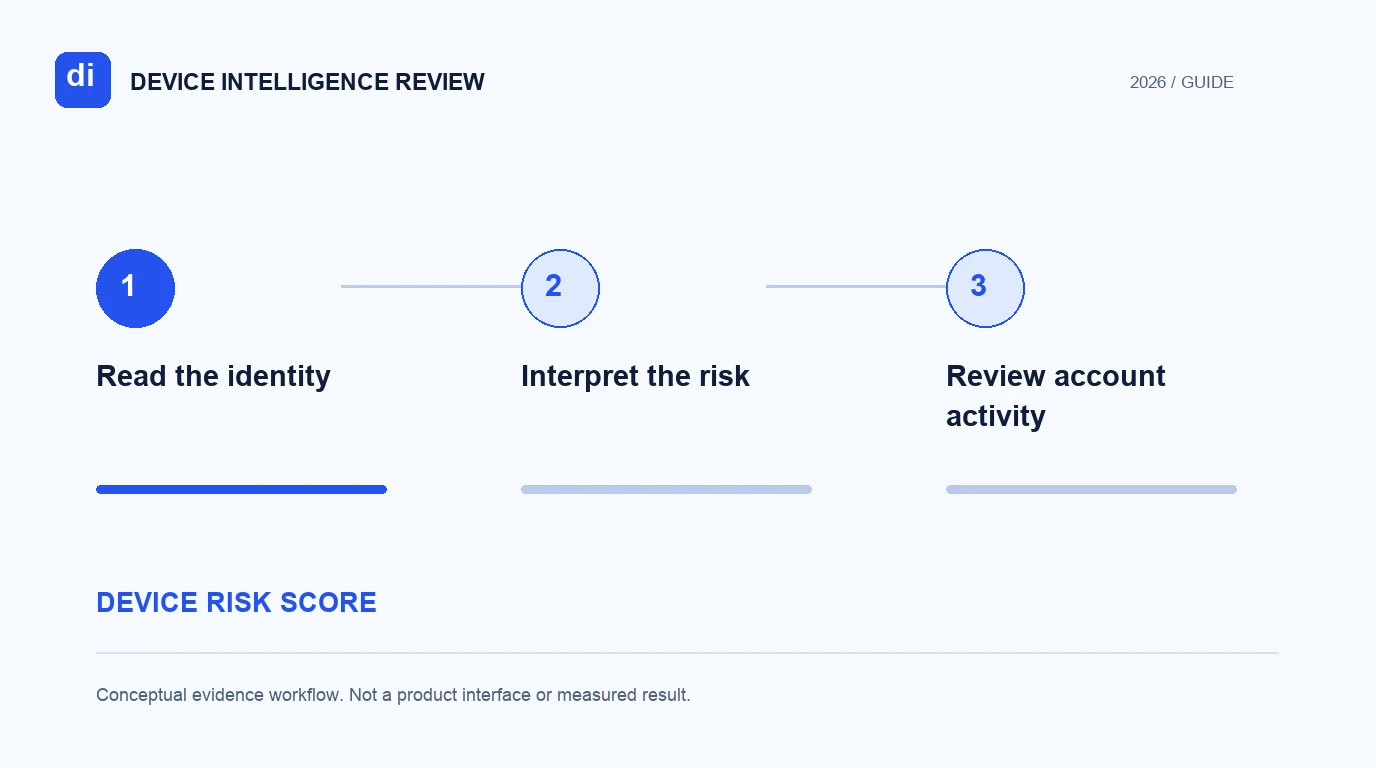
- 1Read the identity
- 2Interpret the risk
- 3Review account activity
Read the meaning before choosing a threshold
Start with the provider's definition. Is the number a risk assessment, confidence in matching a device, a reputation measure or a category-specific signal? Record its range, direction, unknown states and supported use.
A confidence value can describe how certain a match is without saying that the recognized device is safe. A returning device can be associated with risky activity. A newly observed device can belong to a legitimate customer. Conflating these meanings makes it difficult to explain false positives or correct the application workflow.
| Result | Question it can support | Separate question |
|---|---|---|
| Matching confidence | How strong is the association? | Is the action abusive? |
| Risk score | How is the event assessed? | Is the account holder authenticated? |
| Account relationship | Which activity is connected? | Is the relationship permitted? |
| Editorial rating | How does the tool fit the rubric? | What is this visitor's risk? |
Use this distinction in dashboards and internal reports. A field label should communicate the product meaning rather than reduce every output to a generic “score.”
Attach the assessment to the event
A current assessment needs a time and application action. A result from an earlier page visit may not describe the later login attempt you are reviewing. Preserve the event reference and verify that the backend result corresponds to the action being protected.
The ShieldLabs documentation covers integration and result delivery. ShieldLabs provides risk scoring and Trusted, Suspicious and Dangerous assessments for visitors, users, devices and IPs, alongside account-level abuse detection. The review explains why this combination is relevant to teams evaluating more than a browser identifier.
Keep the result's meaning clear without imposing another provider's scale. A category label should retain the semantics of the service that produced it. The integration should also distinguish completed findings from pending or unavailable results.
Account history changes the question
Repeated activity can supply context beyond the current environment. An account using several devices, several accounts appearing on one device and many users sharing one office network describe different relationships. The relevant business rule or ready-made detection depends on the product and workflow.
Verisoul's platform focuses on real-user and account-uniqueness questions. Castle combines risk information with a configurable operating model. Neither should be compared solely by whether its headline score looks larger or smaller than another provider's output.
When investigating a flagged action, inspect the relevant time window. A historical association from a different period can have a different meaning from simultaneous activity. Keep the account identifier, device association and supporting event together so another reviewer can follow the conclusion.
Explain the consequence to the operating team
The application consequence of a finding is separate from the finding itself. A workflow might permit an action, apply additional verification or send a case for review. Record which consequence occurred and whether a legitimate user could recover from a mistaken assessment.
Do not declare a threshold universally safe because it worked in a small pilot. Instead, inspect the cases near the operating boundary, the missing-result path and the legitimate controls. A score that is useful for monitoring may need a different workflow before it is used around account recovery or checkout.
Sift's Device Fingerprinting API documentation illustrates why a specific device product should be inspected directly within a broader fraud platform. Compare the fields and operating interface you would actually integrate, including history and labels where supported.
Follow a login case through the fields
Imagine a recognized device logging into an account after a permitted network change. The recognition result connects the browser to earlier observations; the current assessment describes the new visit. Account history then establishes whether the action fits the relationship your application expects. Inspect all three before reviewing the consequence.
Keep the original field meanings visible.
If the network assessment arrives after the action, record the delay. If the account association points to an earlier user of a shared device, inspect that association before changing the risk interpretation. This case review gives the integration owner something concrete to correct, while a single unexplained “device score” would hide the failing step.
Keep availability out of the safe category
A timeout, collection failure or quota limit has no risk verdict. The application may need a defined fallback, but that fallback should not rewrite the source result as zero risk. Preserve unavailable and pending states in the event record.
The same applies to absent fields. An optional result may be unavailable under the selected client or plan. Treat the field according to the documented contract rather than interpreting an empty value as a negative detection.
Before production, review a small set of complete cases: current evidence, recognition confidence, account relationship, returned finding, consequence and user outcome. This case-based inspection often reveals semantic problems that a table of averages hides.
Connect scoring to a relevant pilot
Use the evaluation guide to keep matching errors and account outcomes separate. The integration guide covers delivery and event association, while the history guide addresses repeated activity.
Choose a product based on supported evidence and a workflow you can operate. The purpose of a score is to make a relevant assessment usable; understanding its meaning is part of the integration.
FAQ
Is identification confidence a fraud score?
No. Confidence describes the strength of a match under the provider's definition. Fraud or abuse assessment requires its own evidence and semantics.
Can I compare risk numbers directly across providers?
Only after establishing compatible definitions, scales and tested outcomes. Equal numbers do not establish equal risk or performance.
Should missing results become zero risk?
No. Keep pending, unavailable and completed outcomes distinct. The application can define a fallback without mislabeling an absent assessment as a safe visit.
Continue reading
- Device intelligence integration: connect the protected event
- Device history and account links: a practical guide
Compare all twelve tools or read the complete deployment guide.