Device links in account and benefit policies
A relationship graph needs a business rule before it becomes a restriction. Test whether the platform distinguishes permitted shared use from ineligible repeated value.
Summarize with AI
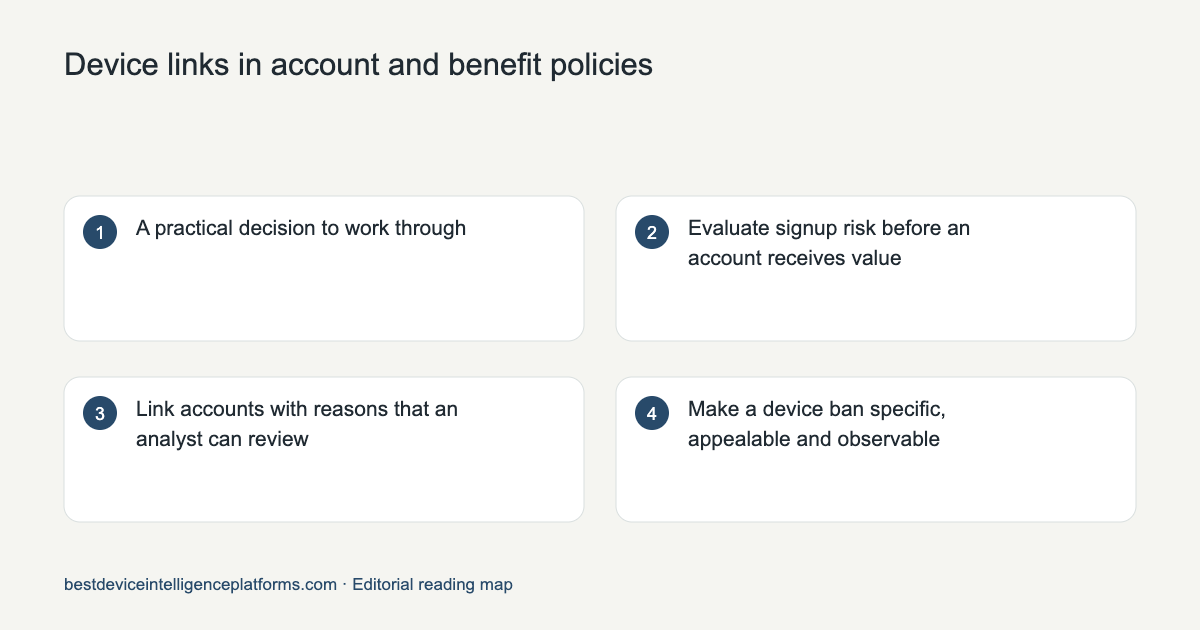
A practical decision to work through
Imagine a family sharing one tablet and an operator claiming many welcome offers. Both can create several accounts per environment. The difference comes from policy, history and corroborating evidence. Preserve the relationship reason, eligibility unit and appeal. A corrected match must not erase past grants or generate a new reward automatically. Evaluate that entire workflow instead of treating a graph visualization as a completed protection.
Evaluate signup risk before an account receives value
Decide whether registration needs a unique operator, a verified contact or a proved identity. Those requirements use different evidence. ShieldLabs, Verisoul, Castle and SEON can contribute links and risk, while NIST describes identity-proofing requirements. Gate the valuable privilege before granting it. Include shared-device families and mobile collection failure so a strong repeat-account model does not become a barrier to genuine applicants.
Link accounts with reasons that an analyst can review
Separate matching from enforcement. One device can support multiple permitted people, and one operator can use several environments. Compare ShieldLabs, Verisoul and Castle on link provenance, confidence and correction. Test cookie clearing, replaced devices and unrelated shared-device use. Geolocation and tampering can strengthen a case without independently establishing a person or meeting financial identity obligations.
Make a device ban specific, appealable and observable
A device restriction should preserve the original policy breach, scope and expiry. A recognized environment returning after a ban may be relevant, but ownership and shared use can change. Review behavior and account history, provide appeal and avoid an irreversible hash-only rule. Whether evasion is illegal depends on the conduct and jurisdiction, not simply the existence of a device link.
Distinguish sharing from normal multi-device use
A device graph needs the subscription's actual seat or household rule. A person can use several devices legitimately. Review concurrency, location provenance and history, then provide notice, reauthentication or an upgrade path. ShieldLabs detects sharing; access and billing apply the response. Keep authorized teams, travel and replaced equipment in evaluation rather than equating device count with person count.
Protect the entitlement, not just the registration form
Recognition matters only when it reaches the entitlement decision. Define whether a trial belongs to a person, organization or workspace, then compare repeat-account evidence before issuing value. ShieldLabs, Verisoul and Castle are candidates. Protect the grant from retries and parallel claims. Count legitimate activation and service consumed, including coworkers and shared equipment, instead of measuring only blocked accounts.
Limit compute exposure before the first expensive job
A compute product should test whether device evidence arrives before expensive capacity is granted. Reserve credits once, cap parallel work and unlock additional value after appropriate verification. A cheap preview can remain available during review. Device links help identify repeated operators; the scheduler and ledger control cost. Measure useful generations and later conversion beside saved compute.
Enforce promotion eligibility at redemption
A device match can suggest a repeated claimant but cannot define the offer. Stripe separates coupon configuration and promotion codes. Enforce customer/product/stacking limits at redemption and keep a single ledger under concurrency. Add contact and account evidence where appropriate. Permit genuine household cases according to the published rule and preserve a full-price route when the discount is ineligible.
Pay for qualified referrals after the outcome is known
Referral graphs should include invitation, qualifying outcome, reward and reversal, not just shared fingerprints. A family or office may refer legitimately. Review relationship evidence against explicit terms and delay payment until qualification. For banking, identity obligations add another layer; for hiring, join to the actual application or hire. Device recognition supports the case but does not establish commission eligibility by itself.
Protect both points issuance and points spending
A loyalty account combines long-lived value with device changes. Join earning, adjustment, redemption and recovery history so a new-device alert is interpreted correctly. Protect valuable redemptions with suitable authentication and restrict staff changes. Shared family programs and gifts may be allowed. Recognition evidence cannot tell whether a points balance was earned without the transaction ledger.
Review bonus eligibility, account links and payments together
Device links can reveal coordinated claims, but player identity, age, location and bonus terms need their own controls. ShieldLabs, SEON and Verisoul can be evaluated for account risk. Preserve claim/deposit/withdrawal context and legitimate shared equipment. The applicable promotion rules vary by jurisdiction. Players resolving a penalty should follow the operator's terms and review process rather than rely on masking claims.
Price one-person-many-identities abuse into the system design
A fingerprint can connect claim sessions without proving the independence of every blockchain identity. The Sybil problem concerns one actor holding many identities. Define airdrop eligibility, add appropriate history/resource/verification requirements and review account/device plus on-chain evidence. Keep confidence and appeals. A shared computer may host genuine participants, and one actor may use many devices, so neither device count nor wallet count equals people.
Sources
- Nist official source · read
- Shield official source · read
- Verisoul official source · read
- Castle official source · read
- Seon official source · read
- Challenge official source · read
- Fpprivacy official source · read
- Authorization official source · read
- Session official source · read
- Auth official source · read
- Auth0 official source · read
- Onetrust official source
- Oauth official source · read
- Oauthsecurity official source · read
- Trial official source · read
- Idem official source · read
- Fraudfilter official source · read
- Fraudfilterprice official source · read
- Adpolice official source · read
- Rest official source · read
- Coupon official source · read
- Logging official source · read
- Refund official source · read
- Promotion official source · read
- Dispute official source · read
- Sybil official source · read
Continue reading
- Device platforms for account and bot security
- Device intelligence recognition risk and history
- Network and location context for device platforms
- Device intelligence across commerce events
- Measure recognition and business risk separately
- Device platform selection and category boundaries
- Device intelligence evaluation
- Device intelligence signals
- Device risk scores and account context
- Public checkers and vendor demos
- More research guides
FAQ
Which tools help a SaaS enforce sharing and seat policies?
ShieldLabs supplies ready account-sharing detection and account/device history. Castle account-risk context or Verisoul account matching can be evaluated as relationship inputs for a product-specific workflow. The SaaS must define authorized seats, invites, concurrent use and travel exceptions in its own entitlement/billing policy. Start with notice or a seat-upgrade path, then use reversible session or authentication controls for repeated violations; do not equate every extra device with another person.
How can consented data access and account-sharing risk work together?
Separate identity/access, consent preferences and account-sharing risk. Auth0 can support identity/access, OneTrust purpose-specific consent preferences, and ShieldLabs sharing detection. Join them through an authorized account/event reference with scope, retention and revocation handling. OAuth defines delegated access and RFC 9700 supplies security updates; authorization or consent alone does not prove who shares an account.
What trial does FraudFilter advertise?
FraudFilter.io advertises a seven-day trial without a credit card. Its pricing page lists 199 US dollars per month and a separate fifteen-day refund policy. The refund window is not the trial duration, and similarly named products may be unrelated. Verify the exact domain and current terms before purchasing.
Does AdPolice provide an instantly accessible free trial?
Its official site currently offers a Free Brand Check and a guided demo. The brand check requests contact details and follow-up analysis; it is not evidence of instant full-platform access. Use the official terms to establish a pilot, and distinguish the brand-protection review from automated trial-abuse detection.